

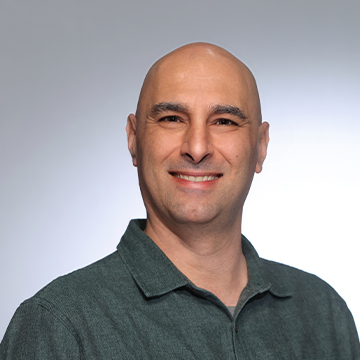
ד"ר עמית ישר


טלפון: 04-8249297
פנימי: (53297)
משרד: 521, בניין חינוך ומדעים
שעות קבלה: בתיאום מראש
אודות
תמיד הפליאה אותי תופעת הראייה: במיוחד כיצד המוח משלב מידע חזותי מקוטע המגיע מן העיניים לכדי אובייקטים מלוכדים – תהליך הנמצא בלב תפקודים תפיסתיים וקוגניטיביים בסיסיים כגון קריאה וזיהוי פנים.
המחקר שלי נמצא בצומת שבין קוגניציה לתפיסה. אני משתמש בשיטות התנהגותיות, פסיכופיזיות וחישוביות כדי לבחון כיצד למידה וקשב יכולים לשפר את התפיסה החזותית. מטרתי ארוכת־הטווח כחוקר היא להרחיב את הבנתנו לגבי הקשרים בין קשב, זיכרון ותפיסה חזותית, ולתרגם את ממצאי המחקר הבסיסי ליישומים קליניים ושיקומיים בתחומי הפרעות ראייה וקשב.
אני מרצה בכיר באוניברסיטת חיפה. את הפוסט־דוקטורט עשיתי במעבדתה של מריסה קרסקו. את הדוקטורט שלי קיבלתי מאוניברסיטת תל־אביב, בהנחיית דומיניק לאמי.
I have always been puzzled by the phenomenon of seeing: particularly how the brain integrates fragmented visual information coming from the eyes into coherent images, a process that is at the core of basic perceptual and cognitive functions such as reading and face recognition. My research lies at the intersection of cognition and perception. I apply behavioral, psychophysical and computational methods to explore how learning and attention can enhance visual perception. my long-term goal as a researcher is to expand our understanding of the links between attention, memory and visual perception, and to translate the findings from this basic research into clinical and neurorehabilitation applications in disorders of vision and attention.
I am a senior lecturer at the University of Haifa. I did my postdoc in the labs of Marisa Carrasco. I received my Ph.D. from Tel-Aviv University, advised by Dominique Lamy.
תחומי מחקר
- קשב, תפיסה וקריאה באוכלוסיות רגילות ומיוחדות (אוטיזם, לקויות קשב ולמידה (כולל דיסלקציה) ולקויות ראייה)
- קשב חזותי: כיצד קשב משפר תהליכי תפיסה ולמידה.
- תפיסה חזותית: זיהוי אובייקטים, כגון אותיות, ותהליכי קבלת החלטות תפיסתיות.
- למידה תפיסתית: שיפור התפיסה החזותית באמצעות שיטות התערבות ואימון.
- מחקר הכולל שימוש במדדים התנהגותיים וניטור תנועות עיניים.
פרסומים
Hochmitz, I., Yeshurun, Y., & Yashar, A. Temporal dynamics of Integration and individuation: Insights from temporal averaging and Crowding. Cognition. [In Press]
Fazioli, L., Hadad, B. S., Denison, R. N., & Yashar, A. Intact integration of reward information during perceptual decision-making in autism. PsyArXiv. [Preprint]
Fazioli, L., Hadad, B. S., Denison, R. N., & Yashar, A. Enhanced metacognition in autism when perceptual decisions rely solely on sensory evidence. PsyArXiv. [Preprint]
Fazioli, L., Abu-Akel, A., Hadad, B. S., & Yashar, A. Validation of the Hebrew version of the Community Assessment of Psychic Experiences (CAPE-42) in a sample of Israeli Hebrew speakers. Frontiers in Psychiatry, 16, 1548310. [In Press]
Fazioli, L., Hadad, B. S., Denison, R. N., & Yashar, A. (2025). Suboptimal but intact integration of Bayesian components during perceptual decision-making in autism. Molecular Autism, 16(1). [PDF]
Yashar, A., & Carrasco, M. (2025). When periphery rules: Enhanced sampling weights of the visual periphery in crowding across dimensions. Psychonomic Bulletin & Review, 1-12. [PDF]
Shechter, A., Medina, S., Share, D. L., & Yashar, A. (2024). Language-universal and script-specific factors in the recognition of letters in visual crowding: The effects of lexicality, hemifield, and transitional probabilities in a right-to-left script. cortex, 171, 319-329. [PDF]
Kewan-Khalayly, B., Yashar, A. (2022). The role of spatial attention in crowding and feature binding. Journal of Vision, 22(13):6. [PDF]
Kewan-Khalayly, B., Migó, M., Yashar, A. (2022). Transient attention equally reduces visual crowding in radial and tangential axes. Journal of Vision, 22(9):3. [PDF]
Jimenez, M., Kimchi, R., & Yashar, A. (2022). Mixture-modeling approach reveals global and local processes in visual crowding. Scientific Reports, 12(1), 6726. [PDF] [DATA]
Hadad, B. S., & Yashar, A. (2022). Sensory perception in autism: What can we learn?. Annual review of vision science, 8(1), 239-264. [PDF].
Kewan-Khalayly, B. & Yashar. A. (2021). The Role of Transient Attention in Crowding and Feature Binding. [Preprint]
Kewan-Khalayly, B., Migó, M. & Yashar. A. (2021). The Role of Transient Attention in the Radial-tangential Anisotropy of Crowding. [Preprint]
Shechter, A., & Yashar, A. (2021). Mixture model investigation of the inner–outer asymmetry in visual crowding reveals a heavier weight towards the visual periphery. Scientific reports, 11(1), 1-12. [PDF] [DATA]
Yashar, A., Wu, X., Chen, J., & Carrasco, M. (2019). Crowding and Binding: Not All Feature Dimensions Behave in the Same Way. Psychological Science, 30(10), 1533-1546. [PDF] [DATA]
Yashar, A., & Denison, R. (2017). Feature reliability determines specificity and transfer of perceptual learning in orientation search. PLoS Computational Biology, 13(12), e1005882. [PDF]
Yashar, A., White, A. L., Fang, W., & Carrasco, M. (2017). Feature singletons attract spatial attention independently of feature priming. Journal of vision, 17(9), 7-7. [PDF]
Yashar, A., & Carrasco, M. (2016). Rapid and long-lasting learning of feature binding. Cognition, 154, 130-138. [PDF]
Yashar, A., Chen, J., & Carrasco, M. (2015). Rapid and long-lasting reduction of crowding through training. Journal of Vision, 15(10), 1-15. [PDF]
Amunts, L., Yashar, A., & Lamy, D. (2014). Inter-trial priming does not affect attentional priority in asymmetric visual search. Frontiers in Psychology, 5, 957. [PDF]
Yashar, A., Makovski, T., & Lamy, D. (2013). The role of motor response in implicit encoding: Evidence from intertrial priming in pop-out search. Vision Research, 93, 80-87. [PDF]
Yashar, A., & Lamy, D. (2013). Temporal position priming: memory traces of recent experience bias the allocation of attention in time. Journal of Experimental Psychology: Human Perception and Performance, 39(5), 1443–1456. [PDF]
Lamy, D., Yashar, A., & Ruderman, L. (2013). Orientation search is mediated by distractor suppression: Evidence from priming of pop-out. Vision Research, 81, 29–35. [PDF]
Yashar, A., & Lamy, D. (2011). Refining the dual-stage account of intertrial feature priming: Does motor response or response feature matter?. Attention, Perception, & Psychophysics, 73, 2160-2167. [PDF]
Lamy, D., Zivony, A., & Yashar, A. (2011). The role of search difficulty in intertrial feature priming. Vision research, 51(19), 2099-2109. [PDF]
Yashar, A., & Lamy, D. (2010). Intertrial repetition affects perception: The role of focused attention. Journal of Vision, 10(14), 3. [PDF]
Yashar, A., & Lamy, D. (2010). Intertrial repetition facilitates selection in time: Common mechanisms underlie spatial and temporal search. Psychological Science, 21(2), 243-251. [PDF]
Lamy, D., Yashar, A. & Ruderman, L. (2010). A dual-stage account of inter-trial priming effects. Vision Research, 14(25), 1396-1401. [PDF]
Lamy, D., & Yashar, A. (2008). Intertrial target-feature changes do not lead to more distraction by singletons: Target uncertainty does. Vision Research, 48(10), 1274-1279. [PDF]
השכלה
Post-doc
Carrasco Lab, The Department of Psychology, New York University (12.2017 – 2.2013)
Ph.D
The School of Psychological Science, Tel Aviv University (12.2012 – 10.2006)
M.A
The School of Psychological Science, Tel Aviv University (10.2004 – 9.2006)
B.A
The Academic College of Tel Aviv (10.1999 – 7.2002)
רקע אקדמי
מדיה
פרסים
2009 Dean’s Honor List for outstanding students in advanced degrees, Tel Aviv University (₪25,000)
2011 Dean’s Honor List for outstanding students in advanced degrees, Tel Aviv University (₪25,000)
2012 The Department of Psychology award for outstanding students in advanced degrees, Tel Aviv University (₪25,000)
2013 The Fulbright Fellowship for postdoctoral students ($37,500)
2015 The Israel Science Foundation (ISF) grant for postdoctoral students in social science ($42,000)
2018 Startup funding for establishing the visual cognition lab at the University of Haifa ($115,000)